

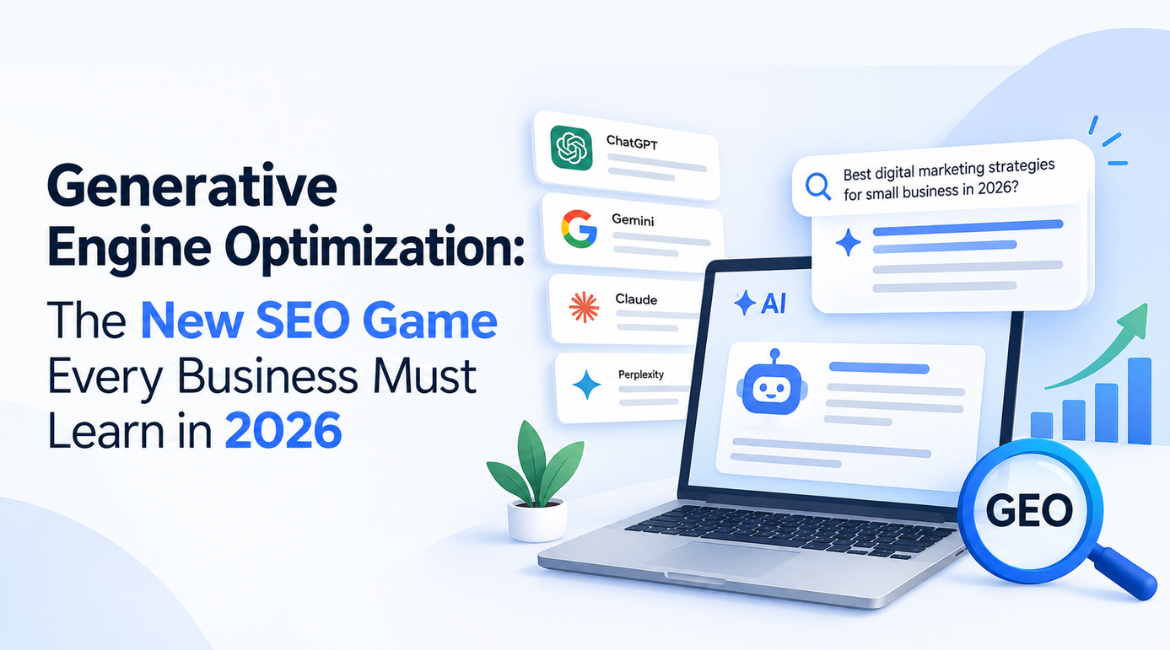
Online searches have become a whole lot different from what they used to be earlier. Previously, people had to type in keywords on Google and click through blue links to find answers to their queries. But now with AI assistants like ChatGPT, Gemini, and Perplexity becoming increasingly popular, a majority of people ask questions to these AI assistants and get their answers immediately without even visiting the websites at all. This shift has led to the rise of yet another concept – generative engine optimization. Businesses ignoring this new concept today may very well miss out on a major source of traffic tomorrow.
If you happen to be a businessman, marketer, or a blogger wondering what is generative engine optimization and why everyone seems to be talking about it, then this article will give you an insight into everything.
What Is Generative Engine Optimization?
Generative engine optimization, popularly known as GEO, involves optimizing your website content in such a manner that AI search engines and chatbots are able to trust and include them as the answer to their user’s queries. Unlike conventional SEO where the goal was to rank on Google, generative engine optimization ensures that you rank in AI-based searches.
In other words, if people start to ask questions based on your industry to any AI tool, then with the help of generative engine optimization, your business, products, or content will be included in that response.
GEO Full Form in Digital Marketing
The geo full form in digital marketing comes up in searches because of the confusion created by the term. The full form of GEO is Generative Engine Optimization. This simply means that you optimize your content to rank on generative search engines as opposed to just the regular search engines such as Google.
Whenever you come across GEO SEO in one sentence, this is simply a combination of the two types of SEOs. One ranks you on the regular search engines while the other ranks you on generative search engines.
What Is GEO in Digital Marketing?
Digital marketers often ask themselves: “What is GEO in digital marketing?” Especially when they notice that they have fewer clicks than before, even though their positions on Google are higher. The answer is simple – it is necessary to create the content strategy in such a way that AI systems could easily read it, summarize, and cite it as a reliable resource.
It is about creating structured, factual, well-written content, using headings, answering questions straightforwardly, and building topical authority. The key point is that generative engine optimization provides websites which give something to people instead of keyword spamming.
Why Generative Engine Optimization Is Important Right Now
There has been a permanent change in the behavior of people while searching. They do not want to read 10 blue links anymore; they expect a quick and reliable answer from the Internet. Chatbots use data from reliable and well-structured websites, and that is when generative engine optimization appears.
It is clear that businesses that do not optimize their websites for generative engine optimization will be ignored in the future. It does not matter that your SEO performance is good because generative engine optimization websites are becoming invisible now.
GEO vs AEO: What’s the Difference?
Geo vs Aeo – another common misunderstanding in the SEO field. AEO means Answer Engine Optimization and its primary aim is making content that appears in direct answer boxes, featured snippets and voice search. On the contrary, the term generative engine optimization means something different because it deals with AI generative models’ interpretation, summarization and reuse of your content.
It means you should imagine the difference between GEO vs AEO as follows: if you want to win an answer box, then use AEO; if you want to become a trustworthy source of content in the AI ecosystem, you need generative engine optimization. That is why many modern SEO specialists consider generative SEO as the next step in AEO evolution.
How to Actually Implement Generative Engine Optimization
Learning about generative engine optimization can be easy but applying it requires much work. Here are some steps to apply GEO:
- Write quality, logically structured content with appropriate headings and short paragraphs
- Answer questions directly without putting an answer at the end of the article
- Build topical authority
- Use statistics and examples to make content more trustworthy
- Make sure that your website is fast, mobile-friendly and easily crawlable
- Update old content regularly for the best results of generative SEO
All these actions will take much time if you have a busy business besides SEO. That is when you need a professional partner to perform SEO activities successfully.
How Websyntra Can Help You With Generative Engine Optimization?
Generative engine optimization is the new thing in the business world now. The Websyntra team includes experts who know how to combine conventional SEO and generative engine optimization to get your brand name on the map, be it on Google or any other AI chatbots.
We help our clients develop their digital footprint using the methods of both conventional and generative engine optimization. By partnering with us for your generative engine optimization, you’ll make sure your company stays relevant and visible online tomorrow.
Common Mistakes Businesses Make With Generative Engine Optimization
There are many companies out there that try to optimize for AI algorithms without even thinking about it properly, resulting in failure. The following are some of the most popular mistakes that businesses make while optimizing their website for AI systems:
- Writing the content in a vague way, failing to answer customers’ questions.
- Ignoring conventional technical SEO optimization rules.
- Concentrating only on keywords rather than valuable content.
- The content should be created primarily for people and only after structured properly for AI systems.
Future of Generative Engine Optimization
With the increasing popularity of AI tools, it is obvious that the importance of generative engine optimization would only rise further in the coming years. According to experts, in a few years from now, a considerable chunk of all the internet searches will take place via AI chatbots instead of the conventional search bar method. Companies that make use of generative engine optimization at present are, thus, ensuring themselves a bright future ahead.
Final Thoughts
Generative engine optimization is changing the dynamics of digital marketing at a faster pace than anyone could have imagined. No matter whether you are the owner of a small-scale business or a big business house, having the knowledge about generative engine optimization and working accordingly would provide you a huge advantage over your competitors. Starting right from learning about the geo full form in digital marketing to the distinction between geo vs aeo, all such information would prove beneficial for you in this digital world.
Frequently Asked Questions
Q.1 What is generative engine optimization in simple words?
Generative engine optimization refers to the optimization of your web content to make it comprehensible by the AI tools such as ChatGPT and Gemini to include it in their responses.
Q.2 What is the geo full form in digital marketing?
The full form of geo in digital marketing is Generative Engine Optimization.
Q.3 How is GEO SEO different from traditional SEO?
While GEO SEO aims to attract the attention of AI generators, traditional SEO is more concerned about ranking in the SERP.
Q.4 What is GEO in digital marketing exactly used for?
GEO SEO is used in digital marketing to increase brand visibility within AI responses and interactions.
Q.5 What is the main difference in geo vs aeo?
The main difference between geo vs aeo is that while AEO aims at taking the direct answer boxes, the latter strives for visibility.
Q.6 Does Websyntra offer support for generative engine optimization?
Yes, we at Websyntra specialize in the combination of SEO and GEO techniques.